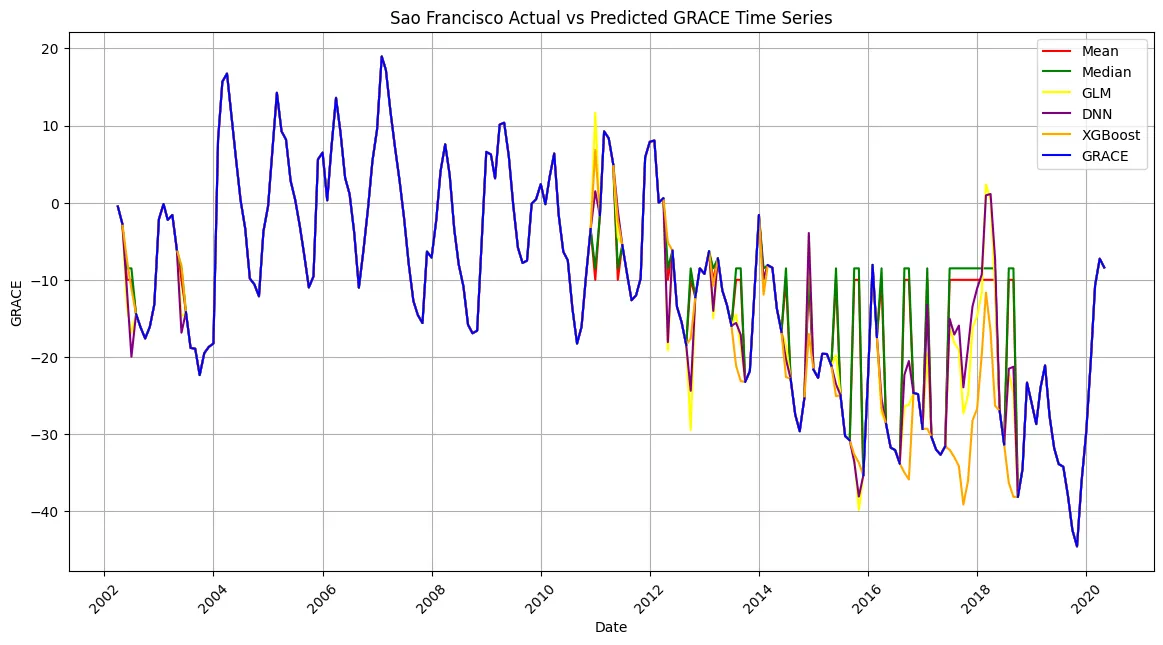
What it is
This study uses statistical and machine learning techniques to impute missing data from GRACE (Gravity Recovery and Climate Experiment) terrestrial water storage (TWS) datasets. We examined information from 2 of the 62 watersheds across the globe, taking into account variables such as temperature, precipitation, evapotranspiration, NDVI, and ENSO. Creating models to predict TWS and efficiently impute missing values was our aim. We investigated techniques including Extreme Gradient Boosting (XGBoost), Deep Neural Networks (DNN), Generalized Linear Models (GLM), and mean/median imputation. Mean Squared Error (MSE) was used to assess these models' performance to choose the most effective method for precise forecasting and imputation.